The Labour government, led by Prime Minister Sir Keir Starmer and Chancellor Rachel Reeves, has faced mounting criticism after reversing several significant policy pledges made prior to and during the 2024 general election campaign.
Over the first 18 months in office, decisions on digital identification, welfare reform, taxation, pensions, benefits, and key social commitments have all undergone notable revisions.
These changes have prompted debate within Parliament, among the public, and across business groups, raising questions regarding the government’s approach to honouring manifesto promises and its ability to manage pressures within the current economic climate.
Digital ID policy reversal
A prominent recent shift concerned the government’s approach to mandatory digital identification for workers. Initially, ministers announced that digital ID would become required for all individuals seeking employment in the UK before the end of the parliamentary term.
Addressing Parliament, Sir Keir Starmer had stated that digital ID would be necessary to work legally in the country. However, the government has since confirmed that while digital right-to-work checks will remain compulsory, other official documents, such as electronic visas and valid passports, will continue to be accepted as alternatives.
A government spokesperson explained that further details about the digital identification scheme would follow a full public consultation, aimed at ensuring the process is inclusive and effective.
Shifts on social and welfare policies
Labour’s position on a range of social security measures has evolved since taking office. The two-child benefit cap, initially enacted by the previous Conservative administration in 2017, faced opposition from many Labour MPs.
In a move welcomed by anti-poverty campaigners, Chancellor Rachel Reeves announced that the cap would be removed from April, at an estimated cost of £3 billion by 2029–30, with government projections indicating 450,000 children could be lifted out of poverty.
Conversely, earlier plans to cut sickness and disability benefits were reconsidered after strong internal opposition; as a result, stricter proposed criteria now exclude current claimants of Personal Independence Payments, and some reductions apply only to new applicants.
Changes to pension policy and winter fuel payments
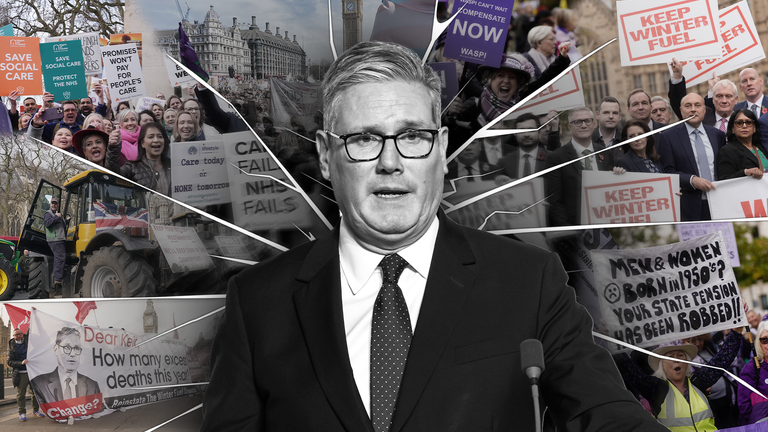
Early in its tenure, the Labour government implemented means-testing for winter fuel payments, restricting eligibility to pensioners on specific benefits, rather than providing the payment universally.
This measure, intended as a cost-saving initiative, faced widespread criticism including from within the Labour Party after it was blamed for the party’s underperformance in subsequent local elections.
Responding to this dissatisfaction, the policy was later amended so that pensioners over state pension age with annual incomes up to £35,000 would remain eligible, restoring support to around three-quarters of pensioners nationwide.
Treasury analysis suggested the new threshold matches average pension income levels and addresses concerns regarding pensioner poverty.
Adjustments to tax and economic strategy
A number of economic policy reversals have been observed, particularly on issues of taxation and fiscal management. Despite manifesto commitments not to raise national insurance for “working people”,
Chancellor Reeves increased employer national insurance contributions from 13.8% to 15% and lowered the salary threshold for employer contributions. Reeves defended the measure as targeting businesses, not employees, arguing that the election pledge pertained solely to individual taxpayers.
Additionally, the government extended the freeze on income tax thresholds originally introduced by the Conservative government and set to end in 2028 by an extra three years. While intended to raise an estimated £8 billion annually by 2029–30, critics labelled the move a “stealth tax” as it is expected to pull around 1.7 million more taxpayers into higher bands.
Government leaders, including Sir Keir Starmer, maintained the changes did not breach Labour’s manifesto and asserted the tax increases were necessary for protecting public services.
Revisions to business and workers' rights
Commitments to overhaul business taxation and deliver enhanced workers’ rights have also undergone modification. The government originally pledged “day one” protection from unfair dismissal in its worker rights bill, but later introduced a revised six-month qualifying period after consultation with business representatives and trade unions.
Business Secretary Peter Kyle described this adjustment as a pragmatic compromise to ensure wider reform could proceed. Labour’s 2024 budget initially attracted criticism from the farming sector for proposed changes to inheritance tax relief on family farms.
Following demonstrations by farmers and intervention by the Prime Minister, policy on agricultural inheritance tax was revised so that only farms valued above £5 million are liable, with tax relief on family transfers raised to £2.5 million an outcome welcomed by the National Farmers Union.
In response to industry concerns over increased business rates for pubs, the Treasury is reportedly preparing a new support package and reviewing the methodology for business rate calculations.
These measures follow the termination of pandemic-era reliefs, which, despite being lower than pre-2020 levels, were deemed insufficient by hospitality leaders due to ongoing financial pressures.

Final Summary
Since taking office, the Labour government has reversed or modified numerous high-profile policies, reflecting ongoing challenges in balancing public expectations, internal party dynamics, and the realities of governance amid economic uncertainty.
While some U-turns have been welcomed by advocates and industry groups, others have fostered discontent among supporters and raised concerns about the durability of campaign pledges. As public scrutiny increases, the government’s approach to policy change and consultation processes is likely to remain under close observation.
For those monitoring the impacts of policy shifts and government announcements, digital tools like the Pie app can assist in staying up to date with real-time developments.